Excellence Is Designed Long Before It Is Delivered
On hospitality as master craft — restraint, rhythm, and the hundreds of quiet decisions that separate the beautiful from the transcendent.
People frequently ask what separates a pleasant celebration from an unforgettable one.
It is a natural question. On paper, most high-tier events rely on identical raw ingredients: a striking venue, fine culinary offerings, rare floral varieties, live music, and polished service.
Yet, two gatherings with identical budgets can leave radically different emotional footprints.
- One is remembered as beautiful.
- The other is remembered as transcendent.
The difference is almost never found in what guests can actively point to or see. It is found in the invisible mechanics designed long before the first door opens.
ASSEMBLY VERSUS CRAFTSMANSHIP
OPERATIONAL ASSEMBLY
Follows Instructions: Executes a static event checklist.INTENTIONAL CRAFTSMANSHIP
OPERATIONAL ASSEMBLY
Governed by the Clock: Measures success by on-time execution.INTENTIONAL CRAFTSMANSHIP
OPERATIONAL ASSEMBLY
Focuses on Addition: Measures luxury by volume and spectacle.INTENTIONAL CRAFTSMANSHIP
Hospitality as a Master Craft
We readily associate the word craft with horology, bespoke tailoring, or fine cabinetmaking—disciplines where artisans dedicate years to perfecting unseen details. We admire a watchmaker because every hidden gear serves a precise mechanical purpose; we appreciate a master tailor because every hand-sewn seam grants mobility and grace.
Hospitality demands the exact same rigor.
A truly memorable guest experience is never simply assembled. Assembly follows rigid instructions; craft begins with deep intention.
At Maison Doclar, every event strategy begins with questions that ignore vendor logistics and focus entirely on human perception:
- What specific emotion should settle over guests within their first five minutes?
- Where do conversations naturally spark, and where do they stall?
- Which moments require stillness rather than performance or speechmaking?
- When should the host step into the spotlight, and when should the experience gently carry itself?
These questions do not yield immediate operational answers. They shape the hundreds of quiet decisions that follow.
The Fallacy of Linear Timelines
Consider how time is managed at a typical event. Most schedules are constructed around rigid clock intervals: 6:00 PM Arrivals, 7:30 PM Dinner, 9:00 PM Toasts.
While operational deadlines matter behind the scenes, guests do not experience time in minutes—they experience it emotionally.
THE DYNAMICS OF EVENT PACING
RIGID LOGISTICAL TIMELINE
The Welcome: 6:00 PM – 6:45 PM.INTENDED EMOTIONAL RHYTHM
RIGID LOGISTICAL TIMELINE
The Seated Service: 7:00 PM – 8:30 PM.INTENDED EMOTIONAL RHYTHM
RIGID LOGISTICAL TIMELINE
The Afterglow: 9:00 PM Onward.INTENDED EMOTIONAL RHYTHM
An evening that rushes guests through courses to hit a rigid schedule will always feel transactional, regardless of how exquisite the food tastes. Conversely, an evening structured around conversational rhythm feels light, unhurried, and deeply enjoyable—even if it lasts late into the night.
- Good hospitality understands clocks.
- Exceptional hospitality understands rhythm.
This principle governs movement throughout a property. Guests should never feel herded from one station to the next. The spatial design should draw them forward naturally:
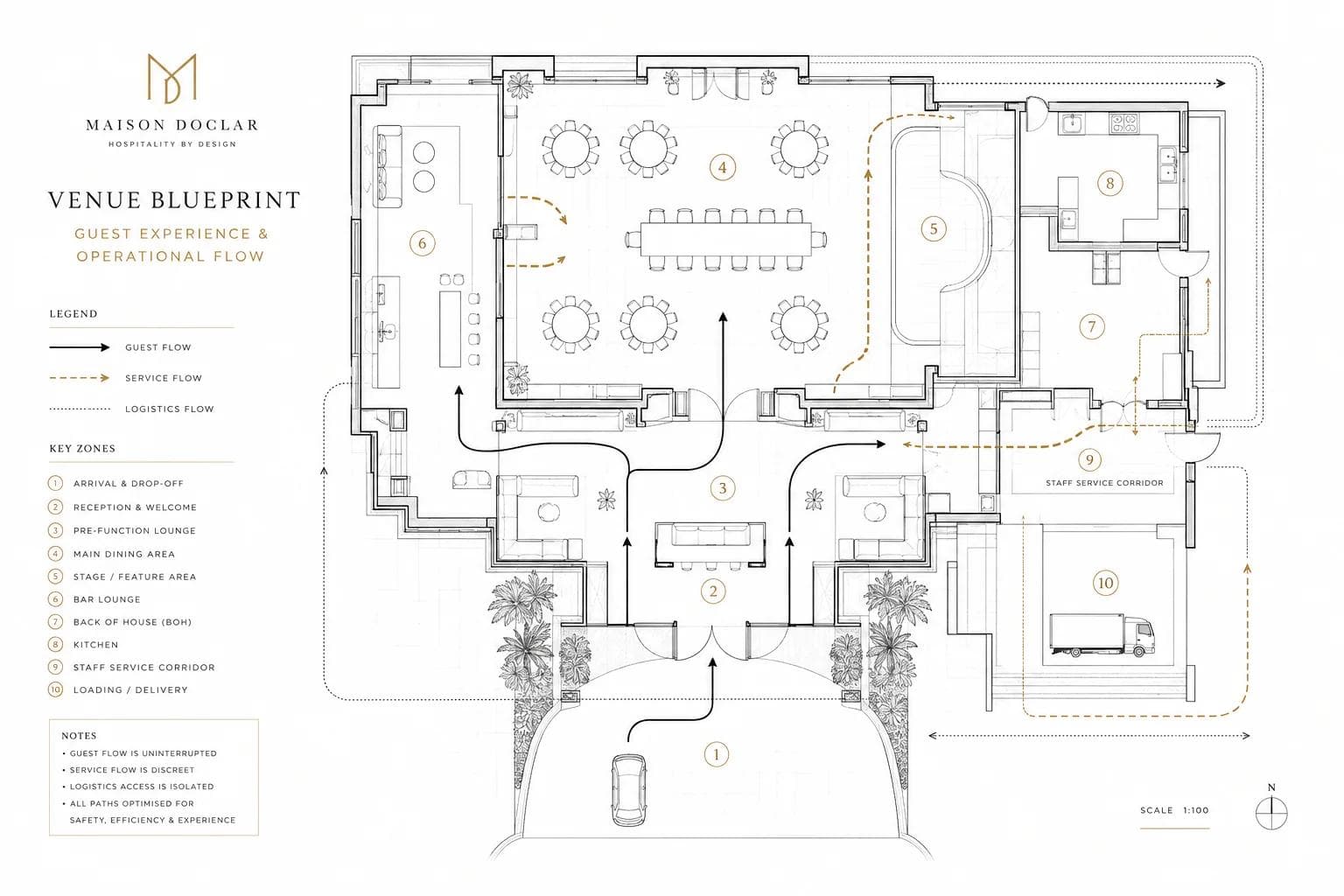
The Natural Flow of an Evening
- Arrival: Frictionless Flow
- Spontaneous Conversation
- Immersive Dining
- Open Celebration
Transitions are where hospitality quietly triumphs or stumbles. A seamless transition passes entirely unnoticed; an awkward pause or sudden relocation instantly breaks the spell.
Restraint as an Act of Confidence
Mastering this invisible craft requires immense patience and the courage to subtract.
During the design phase, the easiest choice is rarely the right one. A seating arrangement may look perfectly balanced on a floor plan, yet subtly separate guests who would have sparked transformative conversations. A room may benefit from removing two tables to give the remaining guests space to breathe. An itinerary is almost always improved by cutting an unnecessary performance to give dinner conversation extra time to flourish.
The Process of Refinement
- Raw Concept
- Addition & Scale
- Subtraction
- Hidden Precision
- Essential Core
- Unnoticed Ease
The discipline of refinement is far more valuable than the impulse toward addition. True luxury has always understood this:
- Master watchmakers do not add complications merely because space permits.
- Architects do not fill every empty alcove with furniture.
- Master chefs know the exact second to stop seasoning.
Restraint is the ultimate form of confidence. Every detail must earn its place—not because guests will explicitly analyze it, but because they will subconsciously feel its absence if it is missing.
The Quiet Victory of “Effortless”
When craftsmanship reaches its peak, its mechanics become completely invisible. Guests depart at the end of the night offering simple praise:
Everything just flowed so naturally. It felt completely effortless.
Those simple words represent hundreds of hours of subterranean calculation, spatial testing, and behavioral psychology. Effortless experiences are never effortless to create. They are crafted—patiently, deliberately, and quietly.
Long after the venue has emptied and the physical details fade from memory, what endures is the quiet feeling that everything unfolded precisely as it was meant to.
That is the beauty of true craft. It asks for no audience or applause—only that every person who steps through the door leaves believing that perfection simply happened on its own.