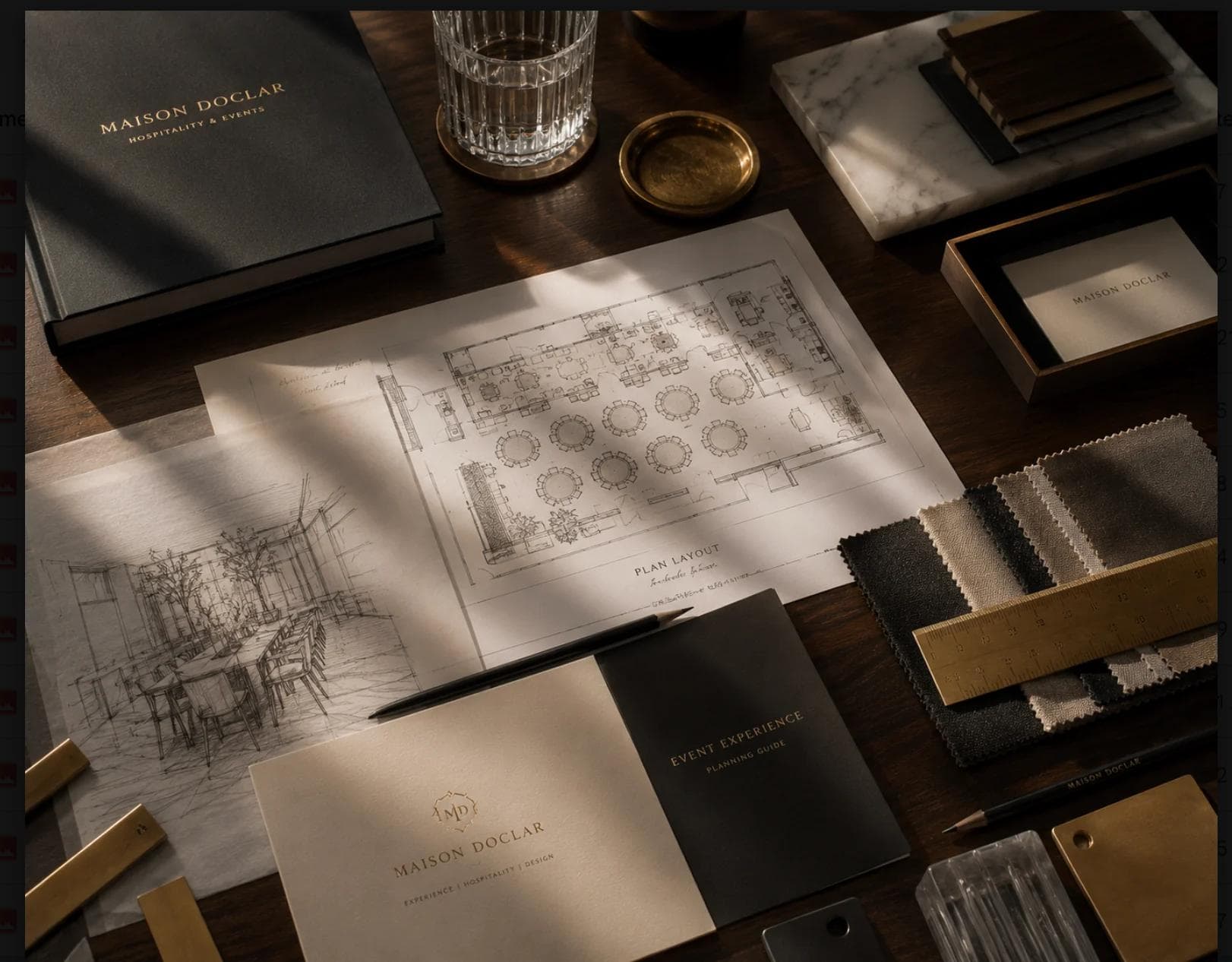
The Legacy of an Evening: Ephemeral Design, Permanent Impact
On the paradox at the center of high-architecture design: the physical build must be ephemeral, while its emotional impact endures for years.
Architecture is not solely measured in stone and mortar, but in the residual warmth left in a room long after the light has faded.
I. Epigraph & Thesis
When the last vehicle departs an estate and the structural scaffolding is struck-dismantled in the quiet hours before dawn, what remains?
To view an occasion through the lens of conventional event production is to focus on the temporary: the physical build, the floral installations, the immediate execution of a menu. Yet, for those who host at the highest tier of private life, these physical components are merely scaffolding. The true deliverable of a grand gathering is intangible. It is a shift in social dynamic, a newly cemented alliance, an indelible emotional resonance that persists for years.
The core thesis of high-architecture event design rests on a single paradox: the physical manifestation of an evening must be strictly ephemeral, while its emotional and cultural imprint must be absolute and permanent. When spatial choreography, light, sound, and protocol are engineered with absolute precision, the physical environment dissolves, leaving behind an enduring legacy.
II. The Invisible Architecture
Every environment generates an emotional gravity. When guests step into a private estate or an engineered temporary structure, their nervous systems unconsciously assess the volume of the space, the warmth of the lighting, the density of the air, and the distance between physical objects.
If this invisible architecture is miscalculated, guests experience subtle friction. They stand unnaturally close to exits, lower their voices in self-preservation, or feel an ambient urge to depart early. Conversely, when the underlying framework is calibrated correctly, guests transition effortlessly from defensive posture to total immersion.
True luxury guest management is not about over-decorating a space; it is about sculpting human behavior through spatial theory. By treating physical staging as an active psychological tool, we manipulate time, privacy, and intimacy. The environment becomes a silent host, discreetly guiding movement and energy without requiring a single spoken instruction.
III. Principles of Execution
To transform temporary physical interventions into a lasting emotional memory, execution must adhere to four strict principles of structural discretion.
1. The Art of Temporal Sequencing
An evening should never feel like a schedule of forced milestones; it must function as a continuous, unhurried progression. Temporal sequencing requires establishing natural spatial transitions that move guests physically as the energy of the gathering shifts:
- The Threshold: A deliberate, low-lit corridor or garden path designed to allow guests to shed the outside world before entering the main salon.
- The Compression: A tightly contained area for initial arrival drinks, designed to force physical proximity and catalyze conversation.
- The Expansion: A grand opening into the dining space, timed precisely as the initial conversational energy reaches its first peak.
2. Materiality and Environmental Resonance
Plasticity and temporary fixtures destroy the illusion of permanence. Every tactile surface—from the weight of linen to the cold density of custom-cast bronzeware—must suggest centuries of heritage, even if installed six hours prior. Material authenticity anchors the guest in the present moment, creating a sensory memory rooted in weight, texture, and acoustics.
3. Subtractive Production
Conventional event planning focuses on addition: more lights, larger arrangements, louder sound systems. High-architecture design relies on subtraction. We strip away any element that does not directly serve guest comfort, privacy, or intimacy. Service corridors are engineered out of line-of-sight, technical cabling is integrated into structural walls, and service staff move within choreographed shadows.
4. The Departure Threshold
The final five minutes of an evening dictate how the previous five hours are remembered. The egress sequence must be engineered with the same rigor as the arrival. Controlled warmth, seamlessly coordinated private transport, and a quiet, unhurried departure zone ensure that the evening ends on a note of absolute composure, rather than chaotic logistics.
IV. Failure Modes of the Conventional
The collapse of an evening's potential rarely stems from catastrophic technical failures; it stems from small, unconsidered friction points that shatter the atmospheric illusion.
- Over-Illumination: Bright, uncalibrated lighting that exposes the temporary nature of the setup or renders guests self-conscious.
- Intrusive Choreography: Service teams that break the flow of conversation with overly rigid or performative serving rituals.
- Spatial Disconnect: Placing a small gathering inside a massive hall without sub-dividing the space through lighting gradients and structural drapery, resulting in a cold, dissipated energy.
- Logistical Friction: Visible strike teams, sound checks, or service delays that reveal the mechanics behind the curtain, stripping the experience of its magic.
V. The Residue
By sunrise, the custom-built pavilions are dismantled, the estate gardens are restored to their pristine silence, and not a single trace of the physical architecture remains.
Yet, in the weeks and years that follow, the evening endures. It lives in the memory of an effortless conversation held in a perfectly dampened acoustic alcove; in the feeling of absolute ease created by unseen security protocols; in the quiet recognition among peers that they participated in something truly unrepeatable.
This is the ultimate standard of private affairs: constructing a moment so complete in its execution that while the physical structure disappears, its impact becomes a permanent chapter in the legacy of the host.